The Challenge
Each sales team ran its own pipeline in its own tool, with its own definitions. Leadership had no consolidated view of the funnel, forecasts were assembled by hand in spreadsheets, and there was no enforced process around deal stages or approvals.
Our Approach
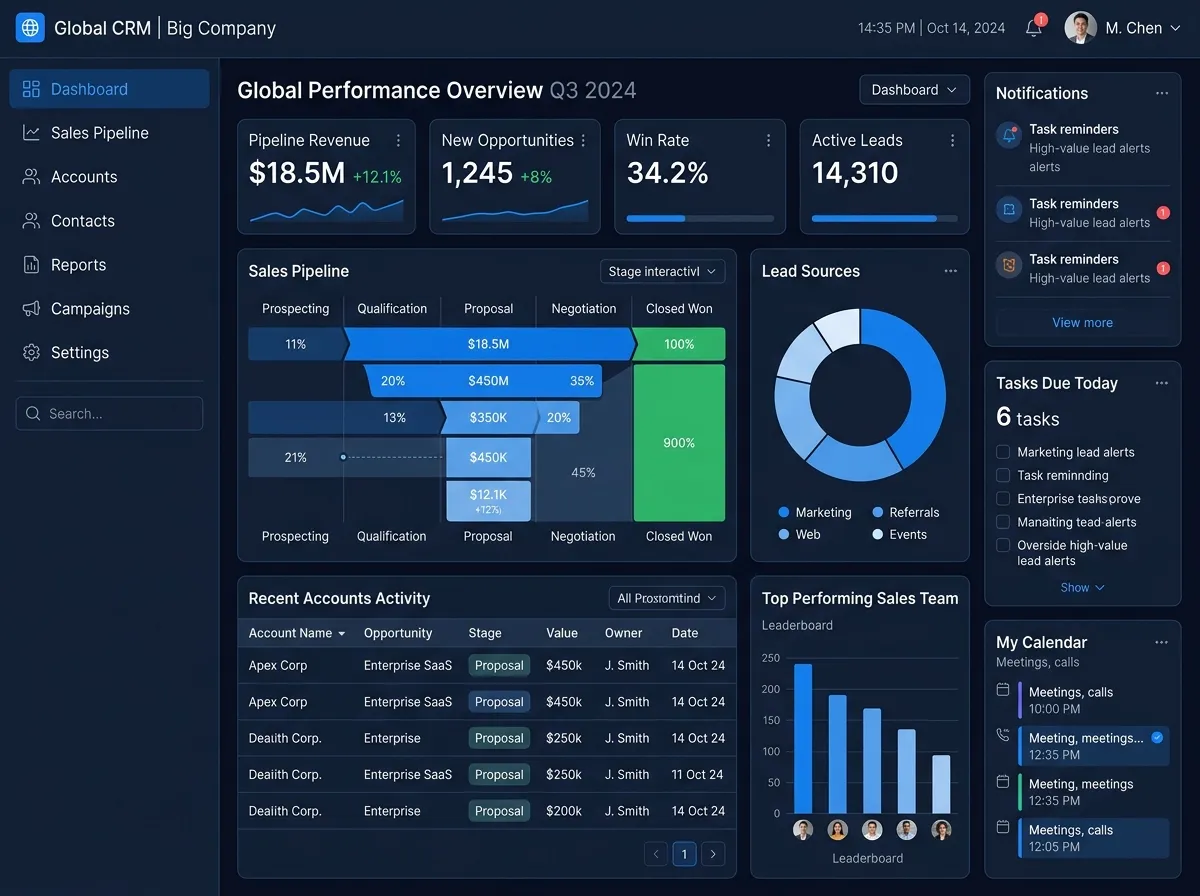
We built an enterprise CRM around a single, enforced pipeline model: configurable stages, role-based permissions, approval workflows for deals and discounts, and forecasting dashboards that roll every team up to one number.
What We Built
Multi-Team Pipeline
A shared pipeline model with per-team views and stage definitions.
Role-Based Permissions
Granular access so reps, managers, and admins each see exactly what they should.
Approval Workflows
Deal and discount approvals encoded in the system instead of email threads.
Forecasting Dashboards
Revenue forecasts that roll up from every team to a single leadership view.
Data Migration
Clean, validated migration from the legacy tools and spreadsheets.
Third-Party Integrations
Connections to the systems the organization already runs on.
The Outcome
Sales now runs on one source of truth. Leadership sees the full funnel and a defensible forecast, and the approval process that used to live in email is now enforced by the system.
Key Results
- One Source of Truth — Every team works from the same pipeline definitions and data.
- Leadership Visibility — The full funnel and forecast are a dashboard, not a spreadsheet exercise.
- Enforced Process — Approvals and stage changes are governed by the system, not by memory.